


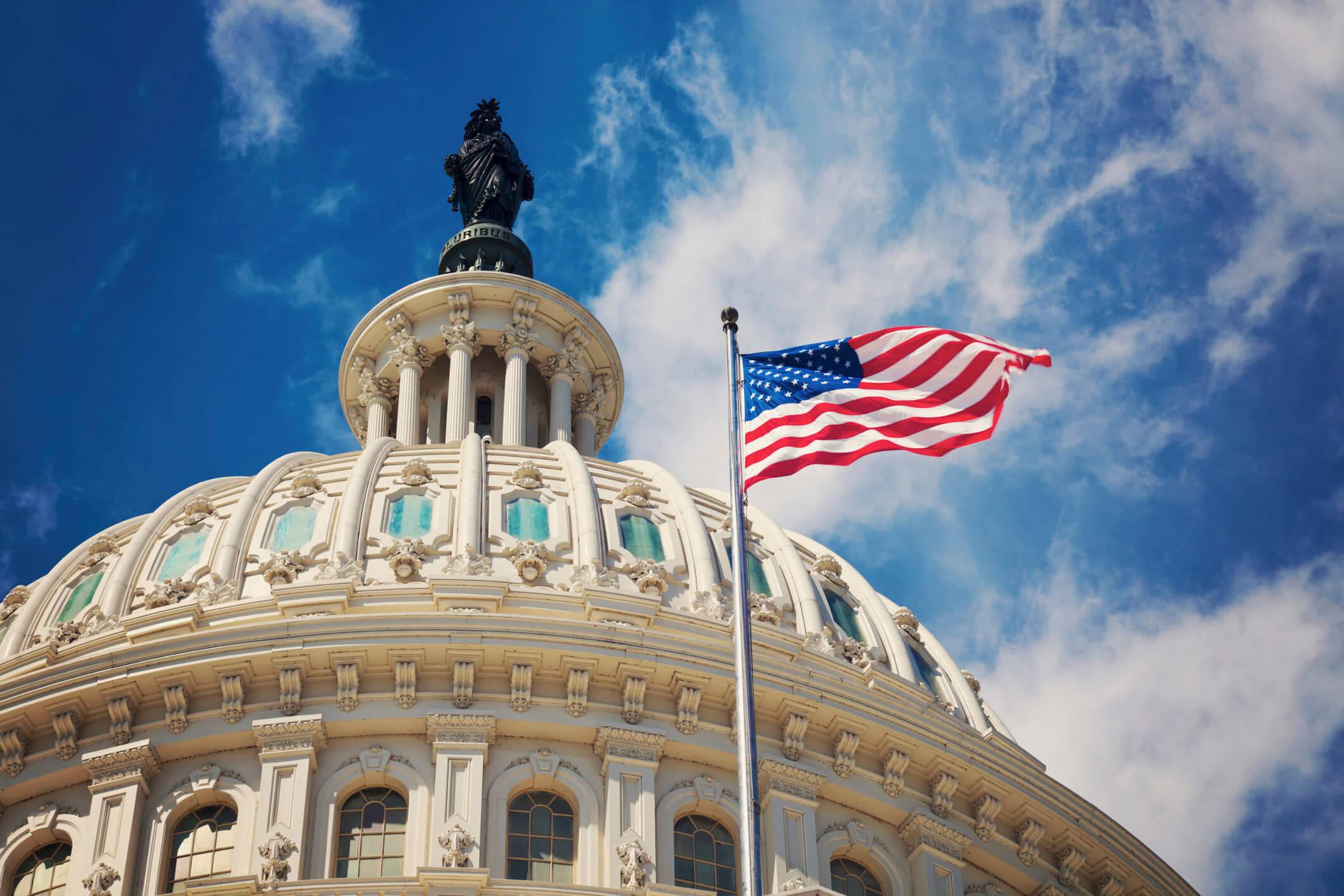
Catching Up With Congress. Lawmakers returned to Washington, D.C., this week, following the July 4th recess and with the clock ticking down on the 119th Congress. The U.S. House of Representatives is scheduled to remain at work in D.C. through July 23, 2026, while the U.S. Senate is scheduled to stay the course through August 7, 2026. The House will return from Congress’s traditional annual August recess on August 31, 2026—but then promptly leave for a five-day Labor Day recess the week beginning September 7 (returning to action on September 14)—while the Senate is slated to return on September 14, 2026.
What does all this mean? Since Republicans control both chambers of Congress, they will try to use this period to advance a legislative agenda that they believe will improve their chances of success in the midterm elections, which are now only 109 days away. (Election Day is November 3, 2026.) Accordingly, they will try to move a third reconciliation bill (employing the same process they used to pass the One Big Beautiful Bill Act in 2025 and the immigration funding package earlier this year), which could include earmarks for defense spending and farm subsidies, as well as certain election reform elements. Moreover, as discussed below, the agenda will prioritize advancing agency nominees through the Senate confirmation process. The Buzz continues to monitor the status of the Faster Labor Contracts Act, which passed the U.S. House of Representatives in June 2026, and is currently under consideration in the U.S. Senate.
In more somber news, after the untimely passing of Senator Lindsey Graham (R-SC) on July 11, 2026, South Carolina Governor Henry McMaster appointed the late senator’s younger sister, Darline Graham Nordone, to serve out the remainder of his term, which will expire on January 3, 2027. Nordone is the first woman to represent South Carolina in the U.S. Senate. While spouses have stepped in to replace senators who have died in office, Nordone is the first sibling to do so. With Senator Nordone now sworn in, Senate Republicans continue to maintain their 53–47 majority.
The Buzz remembers Senator Graham for his staunch opposition to National Labor Relations Board policies related to micro-units and ambush elections. Graham was also a member of the Senate’s “Gang of Eight,” who drafted and championed the comprehensive immigration reform bill, the “Border Security, Economic Opportunity, and Immigration Modernization Act” (S. 744), which passed the Senate in 2013 by a vote of 68–32, but later died in the House.
DHS/ICE Finalizes Rule Limiting Foreign Student Visa Stays. Today, July 17, 2026, the U.S. Department of Homeland Security’s (DHS) Immigration and Customs Enforcement (ICE) published a final rule, “Establishing a Fixed Time Period of Admission and an Extension of Stay Procedure for Nonimmigrant Academic Students, Exchange Visitors, and Representatives of Foreign Information Media,” in the Federal Register. Like the proposed rule issued in August 2025, the final rule eliminates the current “duration of status” framework, which permits nonimmigrant students or exchange visitors to be admitted to the United States for the course of their studies or authorized programs.
In its place, the final rule installs a “period of stay” requirement that limits the admission and extension periods for nonimmigrant students and exchange visitors to the length of their specific programs, not to exceed a four-year period. The rule permits nonimmigrants to apply for an extension of stay beyond the fixed period, but it also places limitations on nonimmigrant students’ abilities to transfer schools or change their “educational objectives.” According to the rule’s preamble, the rule is necessary because the increased number of foreign nationals living in the United States on these visas, coupled with existing regulatory requirements, “has undermined DHS’s ability to effectively enforce compliance with the statutory inadmissibility grounds related to unlawful presence and has created incentives for fraud and abuse.” The final rule will take effect on September 15, 2026.
Tina H. Ho, Kara K. Lancaster, Brittani B. Holland, Nicole M. Antonio, and Larkin Dykstra have the details.
NLRB Nominees Advance. On July 15, 2026, the Senate Committee on Health, Education, Labor and Pensions (HELP) voted to advance the nominations of James R. Macy and David M. Prouty to the National Labor Relations Board (NLRB). Macy currently heads the U.S. Department of Labor’s Office of Workers’ Compensation Programs, while Prouty serves as a member of the NLRB and has been nominated for another five-year term on the Board. As the Buzz has previously discussed, if confirmed, Macy would provide a third affirmative vote, joining Republican members, James Murphy (the Board’s chair) and Scott Mayer, to overturn Biden-era Board precedent. The nominations of Macy and Prouty await a full vote on the floor of the U.S. Senate.
Nominations, of course, are not guaranteed to lead to Senate confirmations. Further, the Senate’s legislative calendar might not yield speedy confirmation votes and could even lead to disruptions at the Board. As noted above, the Senate is currently scheduled to be in session through August 7, 2026, at which time it is expected to recess until September 14, 2026. It is quite possible that the Senate could adjourn for its August recess without confirming Macy or Prouty. In this scenario, the Board would lose its quorum when Prouty’s term expires on August 27, 2026. A loss of quorum—even temporarily—would delay any potential rollbacks of existing law and likely increase the case backlog that the Board has had great success in decreasing.
It’s That Time Again. On July 14, 2026, by a vote of 308–117, the House of Representatives passed the Sunshine Protection Act of 2025 (H.R. 139), which was included as a provision in the Motor Vehicle Modernization Act. The bill would make daylight saving time permanent throughout the United States. We’ve seen this before. A previous version of the bill passed the Senate in March 2022. And as the Buzz noted back then, the nation had previously experimented with instituting year-round daylight saving time.
In 1973, President Richard M. Nixon signed into law the Emergency Daylight Saving Time Energy Conservation Act, instantiating the concept of daylight saving time permanence. The Emergency Daylight Saving Time Energy Conservation Act implemented the time change on a two-year pilot basis, but the results proved so unpopular that Congress voted to repeal the law just eight months into the experiment. (The House voted in favor of repeal by an overwhelming 381–16 margin.)
The Sunshine Protection Act now heads to the Senate, where Senator Tom Cotton (R-AR) has vowed to block it, having declared in a 2025 speech on the Senate floor that he would “always oppose any effort to adopt Daylight Savings Time year-round.”