


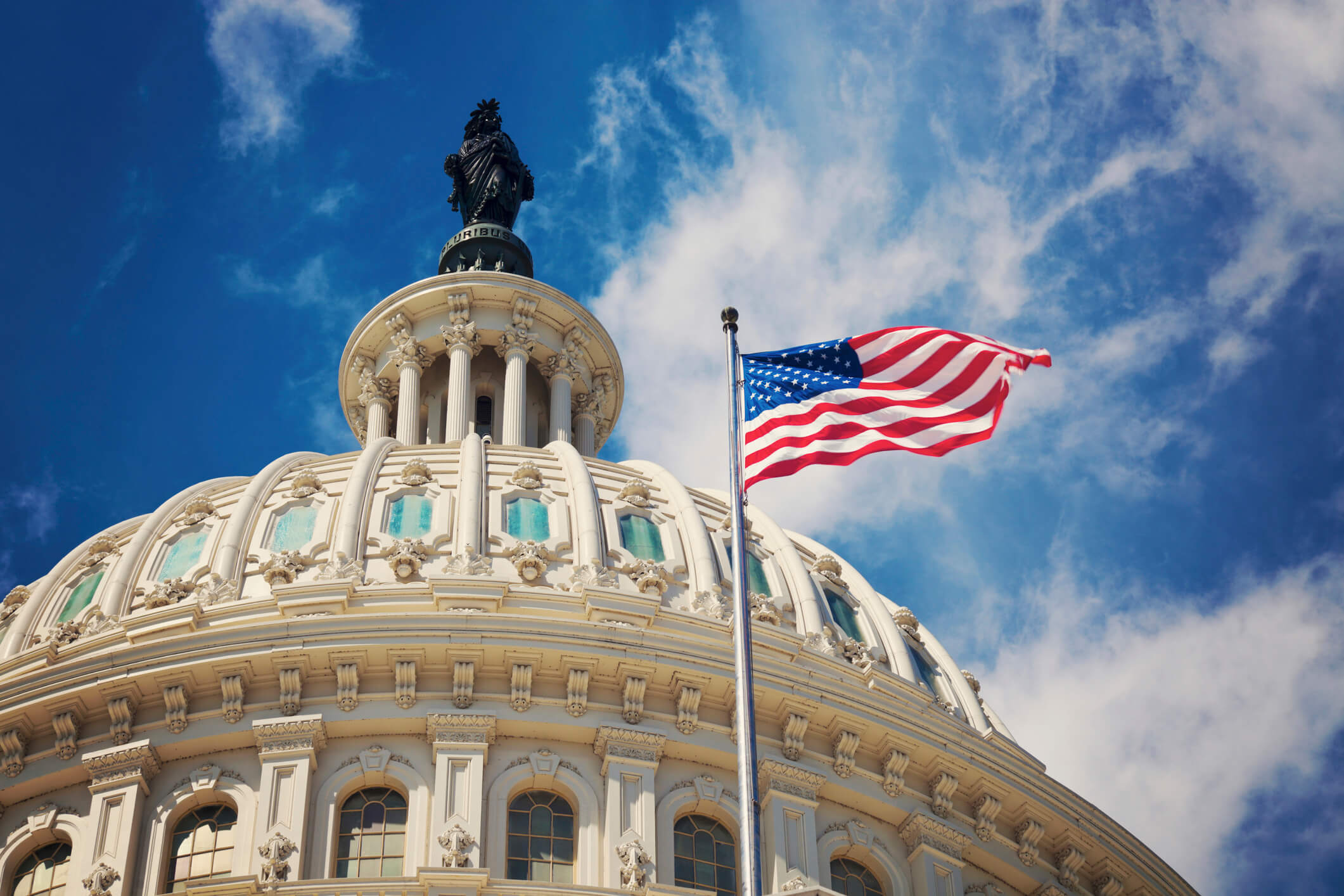
Congress Returns, House Leaves, Midterm Elections Loom. Members of the U.S. Senate and U.S. House of Representatives returned to Washington, D.C., this week after staggered August breaks (the House returned briefly two weeks ago) and convened their respective chambers contemporaneously for the first time since mid-July 2026. The return was short-lived. In the House, Speaker Mike Johnson quickly canceled any remaining votes for the week—as well as for the next two weeks in which the House was scheduled to be in session—and the House adjourned until after Election Day (November 3, 2026). The Senate is currently scheduled to remain in Washington, D.C., for the final two weeks of September.
Federal Court Pauses Effective Date of ‘Duration of Status’ Rule. On September 14, 2026, the U.S. District Court for the District of Massachusetts issued a ruling staying the effective date of the U.S. Department of Homeland Security’s (DHS) Immigration and Customs Enforcement (ICE) rule, “Establishing a Fixed Time Period of Admission and an Extension of Stay Procedure for Nonimmigrant Academic Students, Exchange Visitors, and Representatives of Foreign Information Media.” The rule—slated to have taken effect on September 15, 2026—establishes a strict “period of stay” requirement that limits nonimmigrant students and exchange visitors to four-year stays. (The prior “duration of status” framework allowed such individuals to stay in the United States for the course of their studies or authorized programs.)
The court found that the rule was arbitrary and capricious under the Administrative Procedure Act, reasoning that ICE had not (1) conducted a reasoned cost/benefit analysis; (2) meaningfully considered alternatives; (3) responded to significant public comments; or (4) demonstrated a rational connection between the final rule and its purported objectives.
According to the court, “[I]n support of its own position, [ICE] offered almost entirely conclusory statements, non sequiturs, and statements of ‘belief’ without supporting reasoning.” Regarding relief, the court noted that vacatur of the rule might “ultimately prove to be appropriate” but ultimately chose “the more cautious approach of postponing the effective date of the Final Rule.” Further, to prevent “chaos and confusion that a party-specific order would inevitably generate,” the court held that its injunction applied nationwide. At least for now, the rule is not in effect, and the “duration of status” framework remains in place. Ashley K. Kerr has additional details.
Immigration Regulatory Proposals Advance. This week, two new rules impacting employment-based immigration took significant steps forward in the rulemaking process:
- The Office of Information and Regulatory Affairs (OIRA) completed its review of DHS/ICE’s proposal to implement a fee component for foreign national students’ participation in the Optional Practical Training program. Many expect the fee to be approximately $100,000, consistent with the administration’s efforts to attach this amount to H-1B visa petitions. Now that OIRA has completed its review, DHS/ICE is expected to publish the proposal imminently.
- A bit further behind in the regulatory process is the U.S. Department of Labor’s proposal to make changes to the permanent labor certification process (PERM) program, which was just sent to OIRA for review this week. According to the abstract in the most recent Regulatory Agenda, “the Department will seek to modernize the standards and procedures by which the Department receives and reviews employers’ applications for permanent labor certification by improving the minimum standards for recruiting qualified U.S. workers, strengthening safeguards for U.S. workers impacted by layoffs, and enhancing employer compliance with program requirements related to non-discriminatory recruitment and hiring practices.” The OIRA review process can take weeks, and once it is complete, the DOL will release the proposal for public comment.
Bill Would Create Premium Processing for PERM Applications. Speaking of PERM, Representatives Glenn Grothman (R-WI) and Lou Correa (D-CA) have introduced H.R. 10051, the “PERM Backlog Reduction Act of 2026.” The bill would create an optional premium processing program to provide for completion of the DOL’s Permanent Employment Certification Form—which is required for permanent employment-based immigration petitions—within thirty days, for a fee of $1,200. The process is similar to premium processing by U.S. Citizenship and Immigration Services (USCIS). The bill is unlikely to move in the current Congress, but it could be worth watching in 2027. While the administration generally hasn’t been amenable to policies that ease immigration, giving the DOL the authority to collect fees could be enticing and may sway Republicans.
Eschbach Tapped for EEOC GC Role. President Trump has nominated Catherine Eschbach to serve as general counsel (GC) of the U.S. Equal Employment Opportunity Commission. Eschbach currently serves as the Commission’s principal deputy general counsel, a position she has held since September 2025. Prior to her time at the EEOC, Eschbach served as director of the Office of Federal Contract Compliance Programs during the early stages of President Trump’s second term. If confirmed, Eschbach is likely to further the administration’s enforcement priorities with respect to alleged DEI-related race and sex discrimination, anti-American national origin discrimination, and religious discrimination, as well as the enforcement of single-sex spaces in the workplace.
Vice President Spiro Agnew. Former U.S. vice president Spiro Agnew died thirty years ago yesterday, on September 17, 1996. Born and raised in Baltimore, Maryland, Agnew became an attorney specializing in labor law and rose through the local Republican political ranks to serve as Baltimore County executive from 1962 to 1966 and as Maryland governor from 1967 to 1969. Agnew resigned as governor when Richard M. Nixon tapped him to serve as his running mate and eventual vice president. (Ironically, in the 1968 presidential election, which Nixon and Agnew won, the ticket lost Maryland with its ten electoral votes.)
Nixon and Agnew were overwhelmingly reelected in November 1972, but Agnew’s time in office would be short-lived. That year, the U.S. Attorney’s Office for the District of Maryland opened an investigation into alleged kickback schemes involving Baltimore County politicians and local construction firms. The investigation revealed that Agnew had received kickbacks on public contracts awarded to a Maryland construction company and that the bribes persisted during his time as Baltimore County executive, Maryland governor, and even as U.S. vice president. On October 10, 1973, Agnew pled “no contest” to one count of tax evasion and resigned as vice president on the same day. Agnew was the second vice president to resign from office (there have been only two to have done so—John C. Calhoun resigned as President Andrew Jackson’s vice president in 1832 to serve as U.S. senator from South Carolina), and Agnew became the only former vice president with a criminal record.