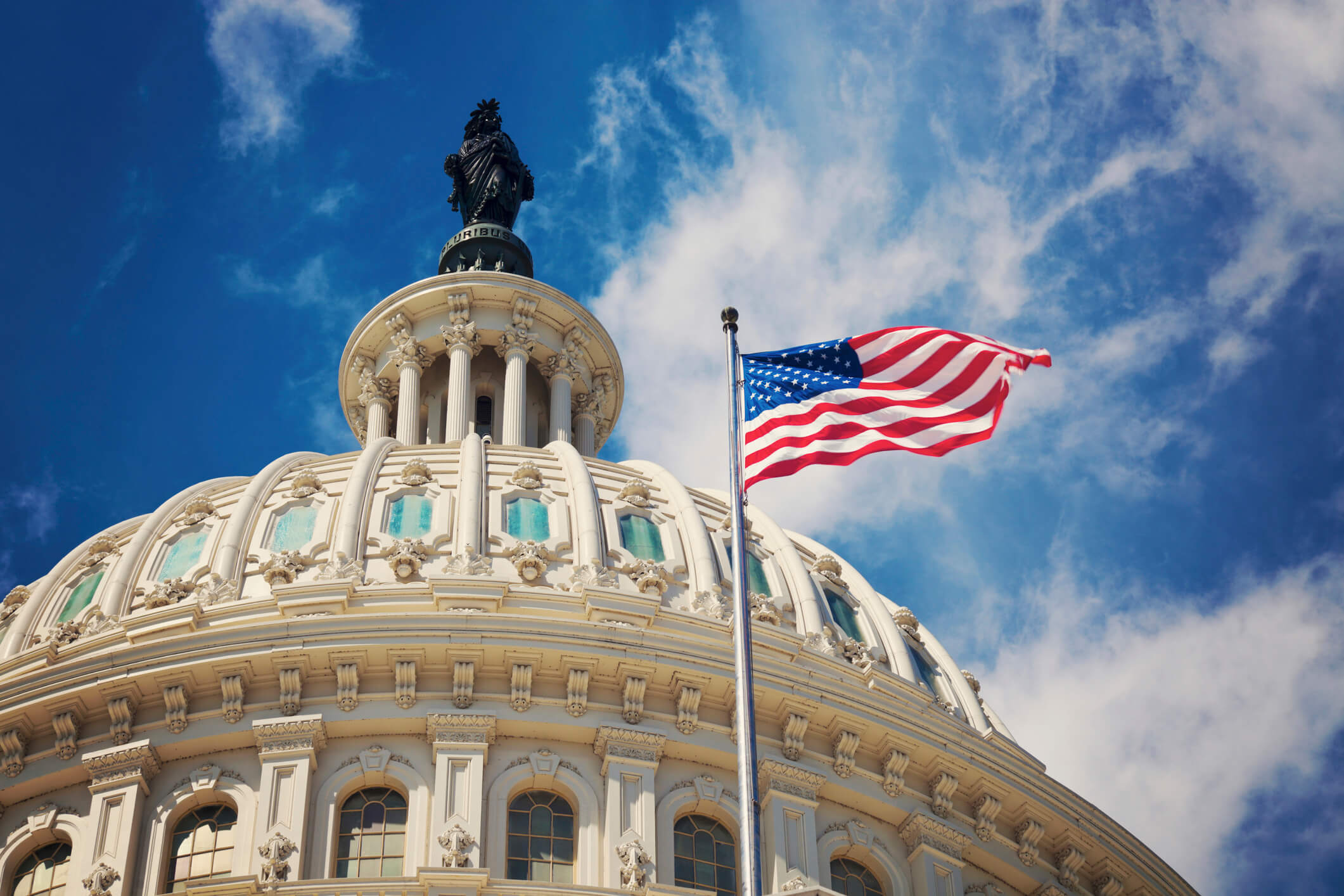
‘Gone Till November.’ This week, the U.S. Senate wrapped up its current legislative period, and its members hit the campaign trail ahead of the November midterm elections. Senators (as well as members of the U.S. House of Representatives) are slated to return to Washington, D.C., on November 9, 2026, for the lame-duck session of the 119th Congress. The political dynamics in that session are sure to be interesting, as we will—theoretically—know where the balance of power will lie in both legislative chambers beginning in 2027. During the “lame duck” legislative waddle, the Buzz will be monitoring the status of the Faster Labor Contracts Act and federal government funding, which, absent congressional action, will expire on December 12, 2026. There are thirty-two days until Election Day.
District Court Blocks Implementation of $100,000 H-1B Visa Fee. On September 30, 2026, the U.S. District Court for the Northern District of California vacated guidance documents issued by U.S. Citizenship and Immigration Services (USCIS), the U.S. Department of State, and U.S. Customs and Border Protection (together, “the agencies”) that implemented President Donald Trump’s Proclamation 10973, which requires employers to include a $100,000 fee with each H-1B petition filed.
Rather than focusing on the president’s authority to establish the fee requirement, the district court focused on the legality of the implementing guidance documents, which “set their own criteria for administering the fee and determining whether to grant exceptions from it.” The court ruled that the agencies violated the Administrative Procedure Act when issuing the guidance documents because they “failed to consider any alternatives or the reliance interests of the regulated parties” (emphasis in the original) or make the policies available for public comment. Importantly, the decision enjoins the agencies from enforcing or implementing the guidance documents issued pursuant to the proclamation, including its extension until September 21, 2027.
This is the second court to block implementation of the proclamation, while a third court—the U.S. District Court for the District of Columbia—upheld the proclamation as a valid exercise of presidential authority. Both of the prior decisions are under appeal. Predicting where this matter will ultimately be decided, the California district court wrote, “[T]he United States Supreme Court is likely to eventually provide further clarity.”
Sonderling Confirmed as Labor Secretary. On September 30, 2026, the U.S. Senate confirmed Keith Sonderling as secretary of labor by a vote of 47–41. Sonderling has served as acting secretary of labor since April 2026; he previously served as a commissioner on the U.S. Equal Employment Opportunity Commission, and, prior to that, was acting administrator of the U.S. Department of Labor’s (DOL) Wage and Hour Division. Sonderling will undoubtedly play a key role in driving the DOL’s regulatory agenda, particularly as the agency seeks to finalize key regulations in the remaining two years of the administration. Key regulatory developments include the finalization of rules addressing joint-employer and independent-contractor tests under the Fair Labor Standards Act, heat injury and illness prevention, and an increase in the prevailing wages that must be paid to certain employment-based immigrant visa holders and H-1B nonimmigrant visa holders.
Senate Approves College Sports Bill. On September 28, 2026, the U.S. Senate passed the Protect College Sports Act of 2026 (S. 4668) by a vote of 77–22. The bill establishes a federal governance framework to address multiple issues associated with college athletics, such as students’ name, image, and likeness rights, student recruitment and eligibility, regulation of sports agents, coaching transitions, and more. As the Buzz has discussed previously, the Protect College Sports Act is hands-off on students’ employee status, as it contains a provision stating that the bill is “neutral on, and does nothing to alter, employee or non-employee status for student athletes.” This contrasts with the House’s own college sports bill, the Student Compensation and Opportunity through Rights and Endorsements (SCORE) Act, (H.R. 4312) which states, “[N]o individual may be considered an employee of an institution, a conference, or an interstate intercollegiate athletic association based on the participation of such individual on a varsity sports team or in an intercollegiate athletic competition as a student athlete.” Therefore, the House and Senate will have to address this issue if a comprehensive legislative solution addressing college athletics is to pass Congress.
Thurgood Marshall Sworn In. Today in 1967, Thoroughgood “Thurgood” Marshall was sworn in as the Supreme Court of the United States’ first Black justice. Marshall, who as chief counsel of the NAACP Legal Defense and Educational Fund successfully argued Brown v. Board of Education, 347 U.S. 483 (1954), would serve on the Court until his retirement in 1991. At the Buzz, we remember Marshall for authoring the 8–1 majority opinion in Emporium Capwell Co. v. Western Addition Community Organization, 420 U.S. 50 (1975), which upheld the discharge of Black employees who picketed their employer to protest alleged racial discrimination, rather than pursue the grievance procedure set forth in their collective bargaining agreement. Marshall viewed the picketing as unprotected concerted activity because it violated the principle of “exclusive representation” embedded in the National Labor Relations Act (NLRA). Marshall wrote, “The policy of industrial self-determination as expressed in [the NLRA] does not require fragmentation of the bargaining unit along racial or other lines in order to consist with the national labor policy against discrimination.” The concept of exclusive representation remains an important—and controversial—topic of labor policy debates.