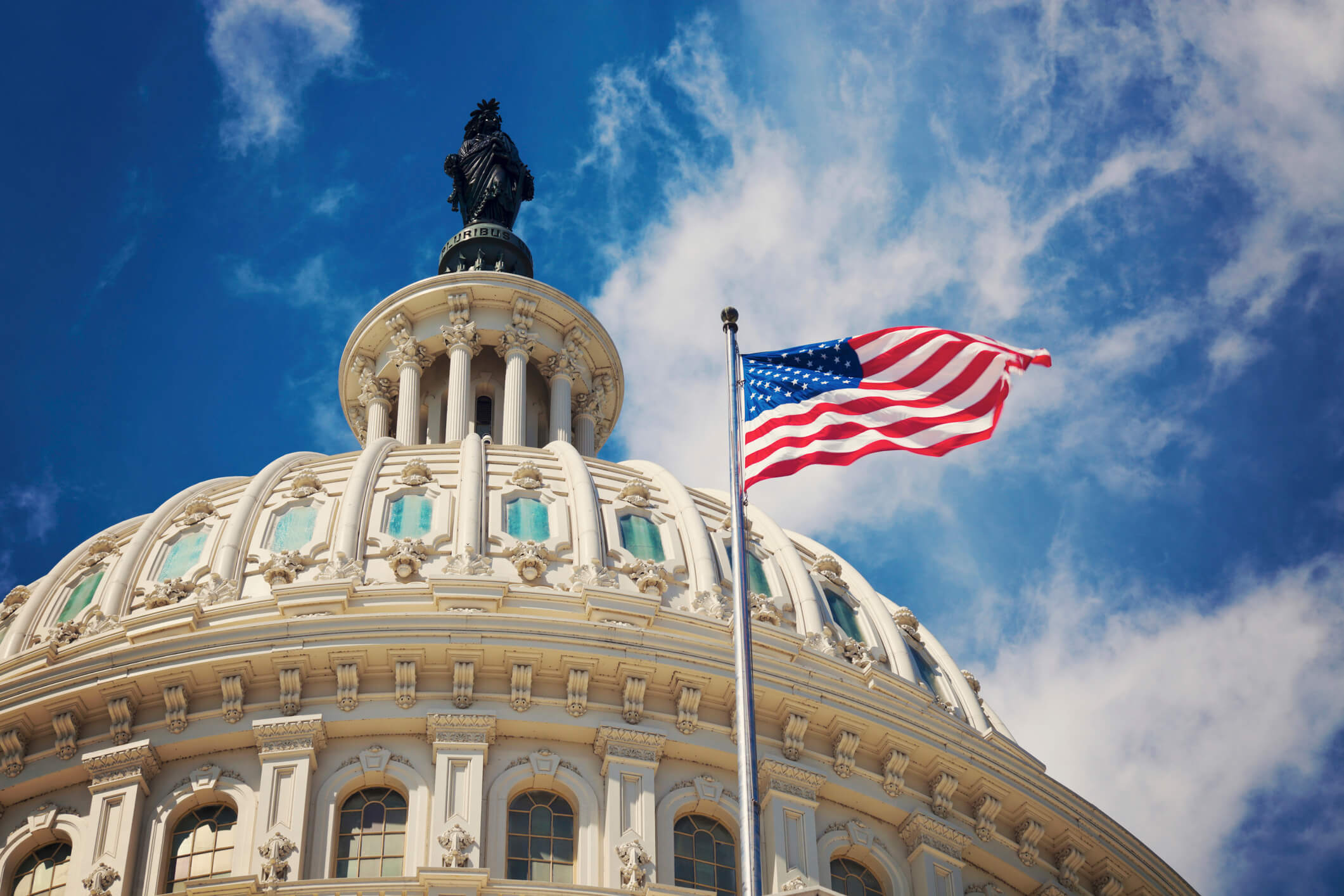
Midterms Preview: What You Need to Know. The 2026 midterm elections will take place on November 3, 2026. When the votes are tallied, the Buzz will provide a full analysis of what the results portend for labor, employment, and immigration policy in the 120th Congress. In the meantime, here are the key details heading into Election Day:
The U.S. House of Representatives
- All 435 members of the U.S. House of Representatives are up for election.
- Republicans currently hold a 220-to-215–seat majority in the House. This includes one independent, Kevin Kiley of California’s 3rd congressional district, who currently caucuses with the Republicans, as well as a vacant Republican seat and a vacant Democratic seat.
- Democrats need to hold their number and flip three Republican seats to gain the 218 needed for a majority in the House.
- If history is a guide, the Republicans will lose their majority in the House. Since 1934, the president’s party has lost an average of 26 House seats in each midterm election. During that timeframe, the only midterm elections in which the president’s party gained seats were in 1934 (President Franklin D. Roosevelt—a gain of 9 seats); in 1998 (President Bill Clinton—a gain of 4 seats); and in 2002 (President George W. Bush—a gain of 8 seats).
- In the 2018 midterm elections, President Trump witnessed a loss of 41 Republican seats.
The U.S. Senate
- In the U.S. Senate, there are 33 seats up for election and 2 seats up for special election. In those special elections, Republican incumbents Jon Husted (OH) and Ashley Moody (FL) are running to complete the Senate terms vacated by Vice President J.D. Vance and Secretary of State Marco Rubio, respectively. Both terms run until 2028. Husted is opposed by former U.S. senator Sherrod Brown (D-OH); Moody is running against former Democratic Florida state representative Angie Nixon.
- Currently, Republicans hold a 53–47 majority in the Senate. This includes independents Bernie Sanders (VT) and Angus King (ME), who caucus with the Democrats.
- Because Vice President J.D. Vance would break any ties in a 50–50 Senate, Democrats need to flip four seats to win the majority.
- Historically, Senate midterm results are less predictable than House results. Senators serve staggered six-year terms, so only about one-third of the chamber is on the ballot in any given federal election year. As a result, Senate races are not viewed as a referendum on the president’s performance in the way House races are.
- In his first term of office, President Trump saw a gain of two Republican seats in the Senate in the 2018 midterm elections.
What’s at Stake?
- Control of the Senate and/or House is the obvious answer, but what does this mean with President Trump in the White House for two more years? In the unlikely event that Republicans are able to hold the majorities in both chambers, they can drive the federal legislative agenda for the next two years and position themselves for the 2028 elections (though as the last two years have demonstrated, passing legislation is always challenging, even with unified control of Congress).
The more likely scenario, however, is that Democrats will win a majority in the House, and potentially the Senate, as well. Democrats will then oversee the various legislative committees and will lean heavily into their oversight authority, knowing that a presidential veto may await most legislation. Even then, Democrats may try to advance legislation to drive the political narrative and serve as litmus tests for 2028.
What’s Next?
- Several weeks remain in the 119th Congress before the 120th convenes. Members of both chambers are scheduled to return to Washington, D.C., on November 9, 2026, for a five-week lame-duck session. The top priority will be funding the federal government beyond December 11, 2026. How lawmakers keep the government open will depend largely on whether power shifts in either chamber in 2027 and on the political leverage that comes with it.
Spooky Season: Senate Pays Tribute to Bats. Prior to absconding from Washington, D.C., for the campaign trail, on September 30, 2026, the U.S. Senate agreed to S. 941, designating this week (October 24, 2026, to October 31, 2026) as “Bat Week.” Bats and Halloween may go together like ghosts and goblins, but Bat Week has nothing to do with the holiday. Rather, the resolution praises bats for “controlling damaging insect pests, pollinating plants that produce fruits and vegetables, dispersing seeds to ensure healthy functioning forests and fields, and saving farmers in the United States more than $3,700,000,000 in pest control every year.” The resolution further warns of the presence of “white-nose syndrome, a fungal disease that has killed millions of bats in North America, has now spread to 41 States and 12 species of hibernating bats.” The resolution concludes with a vow to work to conserve bat species and defeat white-nose syndrome. Clearly, the bat community has hired some good lobbyists.
Next week, the Buzz will be at Ogletree’s Corporate Counsel Exclusive in La Quinta, California, and will be on hiatus. We will return on November 13 with a full analysis of the midterm elections’ impact.