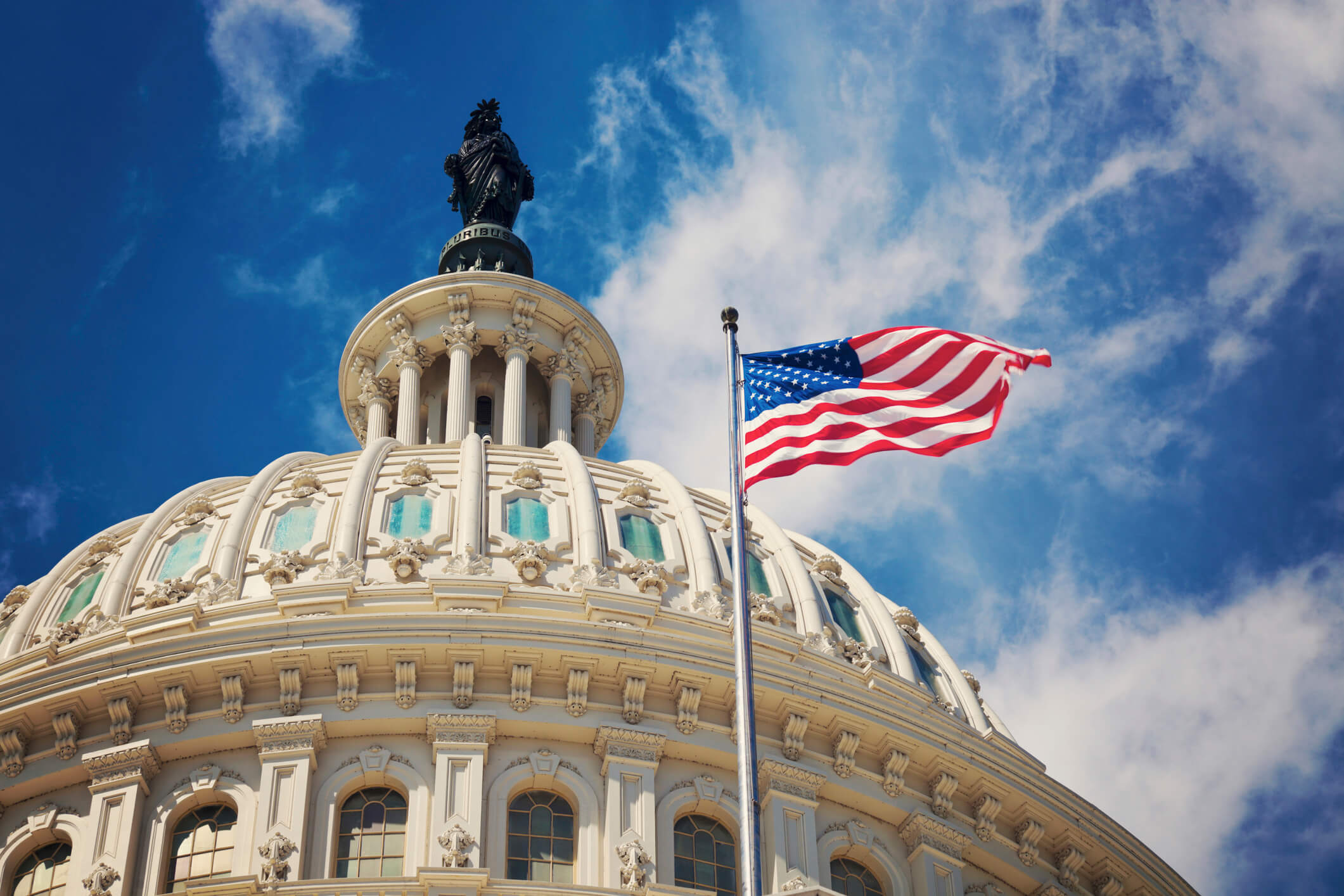
Senate Confirmation Vote Results in Three-Member Republican Bloc at NLRB. Today, the U.S. Senate confirmed a package of seventy-four executive branch nominees. The package included National Labor Relations Board (NLRB) nominees James Macy and David Prouty, a fact that is significant for two reasons. First, if the Senate had left for its five-week August recess before confirming Macy or Prouty, then the Board would have lost its quorum upon the expiration of Prouty’s term at the end of this month. Second, for the first time in this second Trump administration, it presents the Board’s Republican majority with an opportunity to revisit and reverse Biden-era precedent relating to bargaining orders, employer speech, and workplace rules.
State Department Makes Visa Bond Program Permanent. On August 3, 2026, the U.S. Department of State published a final rule establishing a permanent visa bond program. The rule follows on the heels of a twelve-month pilot program, begun in August 2025, which “provided sufficient data to suggest that a visa bond program [was] an effective tool for enforcing compliance among bonded visa holders.” The final rule requires a covered applicant for a business visitor/tourist (B-1/B-2) visa to post a bond of “either $10,000, $15,000, or $20,000, based upon the applicant’s circumstances as determined by the consular officer, unless the bond requirement is waived.” Pursuant to the final rule, bonds will be required from applicants who are “nationals of countries with high overstay rates, deficient information sharing, insufficient identity verification and criminal records, and/or that need improvement in the area of screening and vetting and the security of travel and civil documents.” Sarah Collins and Jessica L. Cross have more on this.
USCIS Issues Update on Benefits Denial Policy. Effective August 5, 2026, U.S. Citizenship and Immigration Services (USCIS) has clarified its policy regarding the evidence applicants must present when applying for immigration benefits. The previous policy encouraged processing officers to seek additional information when an applicant failed to include sufficient evidence in an initial benefit request. According to USCIS, this “prior policy increased processing times, raised costs which [were] transferred to all benefit requestors through filing fees, and encouraged nefarious filing practices such as frivolous and placeholder filings to secure ancillary benefits.” Under the new, clarified policy, USCIS officers may deny incomplete benefit requests without soliciting further information from applicants. Andrew G. Drozdowski, Carolina Izaguirre, and Ashley Laut have additional details.
State Department Proposes Expanded J-1 Termination Criteria. On July 30, 2026, the State Department published a proposed rule—“Exchange Visitor Program–Termination of Program Participation, Extension of Program and Reinstatement to Valid Program Status”—setting forth criteria for the termination of a J-1 exchange visitor’s program participation. The proposed rule would require a program sponsor—and authorize the State Department—to terminate the exchange visitor’s participation in a program when the “exchange visitor falsifies or fails to provide a full and truthful response, information, or documents as part of his or her exchange visitor application or during the ongoing exchange program.” Additionally, the State Department would be given discretionary authority to terminate an exchange visitor’s program when the Department or the U.S. Department of Homeland Security has revoked or canceled an exchange visitor’s visa with immediate effect or when the exchange visitor has engaged in unauthorized employment. The proposal would also eliminate the distinction between minor or technical infractions and substantive violations of the Student and Exchange Visitor Information System’s (SEVIS) recordkeeping rules by requiring program sponsors to correct such errors within 30 days, rather than the current 120-day time frame. Comments on the proposed rule are due by September 28, 2026.
Dems Reintroduce Bill to Prohibit Predispute Arbitration Agreements and Class Action Waivers. Congressional Democrats have reintroduced the “Restoring Justice for Workers Act” (S. 5190/H.R. 9995), a bill that would prohibit the use of predispute arbitration agreements in the workplace and supersede a 2018 decision of the Supreme Court of the United States that affirmed the use of class action waivers to settle workplace disputes. Although the bill is unlikely to gain traction in the remaining months of the 119th Congress (previous versions were unsuccessful in recent Congresses), it raises an issue that Democrats may seek to press should they recapture one or both chambers of Congress in the November 2026 midterm elections.
Senate Democrats Seek to Double the Federal Overtime Premium. On August 5, 2026, five Democratic senators introduced the “Double the Wage for Overtime Act of 2026” (S. 5268), a bill that would amend the Fair Labor Standards Act to increase the overtime premium from one and one-half times the regular rate to two times the regular rate. A House version of the bill (H.R. 9216), introduced on June 9, 2026, currently has twenty-six cosponsors (all Democrats). As with the aforementioned predispute arbitration bill, the Double the Wage for Overtime Act of 2026 could feature prominently in congressional Democrats’ coming legislative agenda.
‘M-I-Z!’ / ‘Z-O-U!’ On August 6, 2026, the U.S. Senate passed by unanimous consent Senate Resolution 833, “Recognizing the 1960 University of Missouri Tigers Football Team for Its Undefeated Regular Season, Orange Bowl Victory, and Claim to the 1960 National Championship.” Normally, these resolutions happen immediately following the celebrated event, so what took so long? It probably has something to do with a controversy surrounding Missouri’s game against the University of Kansas on November 19, 1960. Missouri’s record was 9–0 going into that game, but the Tigers lost to the Jayhawks at home by a score of 23–7. However, weeks after the game, the Big Eight Conference’s faculty committee found that Kansas had violated conference rules when recruiting a halfback (who was retroactively and prospectively ruled ineligible), and the committee ordered Kansas to forfeit its win over Missouri (as well as its victory over Colorado on November 12, 1960). Missouri then went on to defeat Navy, 21–14, in the Orange Bowl to complete an 11–0 season. This week’s resolution doesn’t magically anoint Missouri as college football’s undisputed 1960 national champion, but it does perhaps add a bit to the “Border War” football rivalry, which resumes in just a few weeks when the Missouri Tigers visit the Kansas Jayhawks on September 11, 2026.
The Buzz will be on hiatus next week but will return on August 21, 2026.